
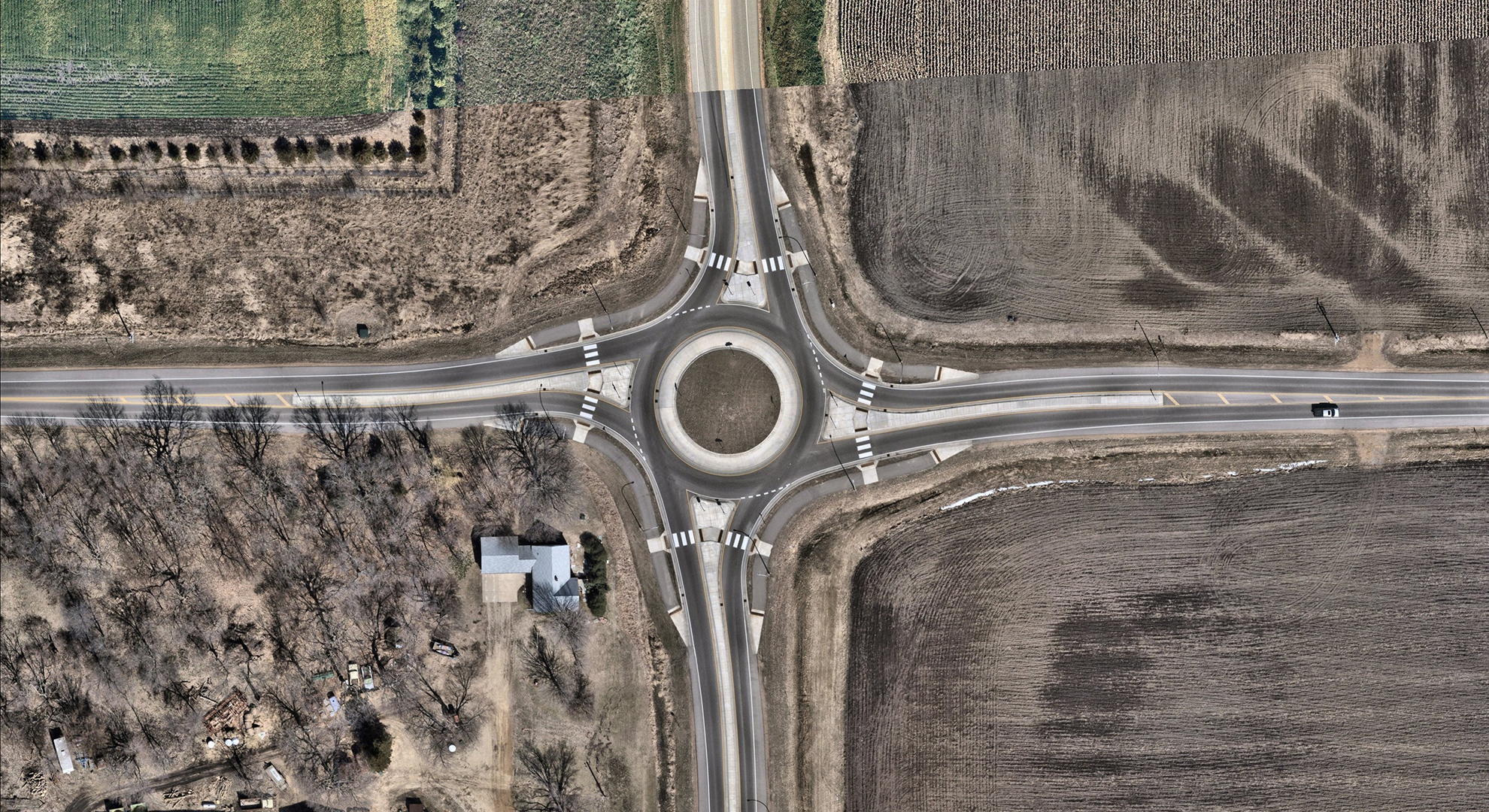
With more than 530 throughout Minnesota as of October 2024, state and local engineers and planners are increasingly relying on roundabouts as a safer and more efficient alternative to traditional intersections. Although it may not be a solution for every type of intersection, a roundabout can be an effective way to slow traffic down at dangerous intersections while still keeping traffic moving. But how do roundabouts perform in rural settings versus urban settings as it relates to speeds and off tracking?
To answer this question, the Minnesota Department of Transportation (MnDOT) collaborated with SRF Consulting Group and the University of North Carolina—Charlotte to study driver behavior at recently built single-lane roundabouts. Using advanced video analysis, the team observed how vehicles and pedestrians move through these intersections and compared design features like curbs, color-contrasted shoulders, and rumble strips. The goal was to understand how roundabout design impacts safety and performance and to identify context-sensitive design improvements for rural roundabouts.
Rural Roundabout Study Overview
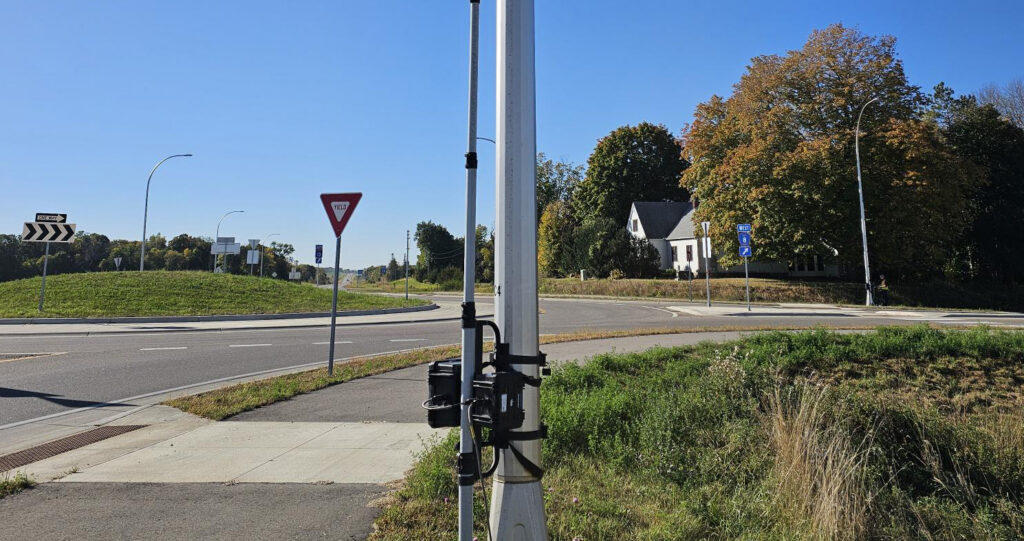
In a partnership with with SRF’s Transportation Mobility team and UNC, MnDOT’s Geometric Design Support Unit (GDSU) analyzed driver behavior at recently constructed urban and rural single-lane roundabouts. The study utilized AI-powered video analysis to collect and process traffic data at four intersections, comparing urban designs (with curb and gutter) to rural designs (without curb and gutter). Deep learning algorithms then processed this footage, automatically tracking vehicles and pedestrians, to create structured datasets for detailed analysis.
Key Findings
- When comparing speeds between rural and urban designed roundabouts, the analysis found that rural roundabouts generally tend to have higher entry and circulating speeds than their urban counterparts when no countermeasures are implemented. While this analysis showed slightly higher speeds on the rural designed roundabouts, the entering speeds for both rural and urban designed roundabouts were within the anticipated range of entering speeds.
- Analysis of gap acceptance (or the process by which a driver determines whether a gap in traffic is large enough for them to safely enter the roundabout) found no notable differences between rural and urban roundabouts. Drivers at both accepted similar gaps. This means single lane roundabouts perform similarly in either setting.
- Vehicle heat map analysis provided the most differentiation between different roundabout designs, identifying the percentage of vehicles traversing outside of the designed lane (off-tracking), which was defined as traversing on the gutter for urban roundabouts and on the striped shoulder for rural roundabouts.
- Urban roundabouts saw no more than 25% of vehicles using the gutter, consistent across locations. There was evidence of vehicles tracking over the curb at the location with trail adjacent to the curb.
- The rural roundabout with countermeasures showed off-tracking under 10%, while the rural roundabout without countermeasures showed off-tracking over 50% and included rutting where vehicles departed the provided pavement.
- Based on this analysis, it is recommended that MnDOT incorporate countermeasures when constructing rural roundabouts, such as rumble strips adjacent to the travel lane, hatching on shoulders, and use of color contrasted pavement for shoulders.
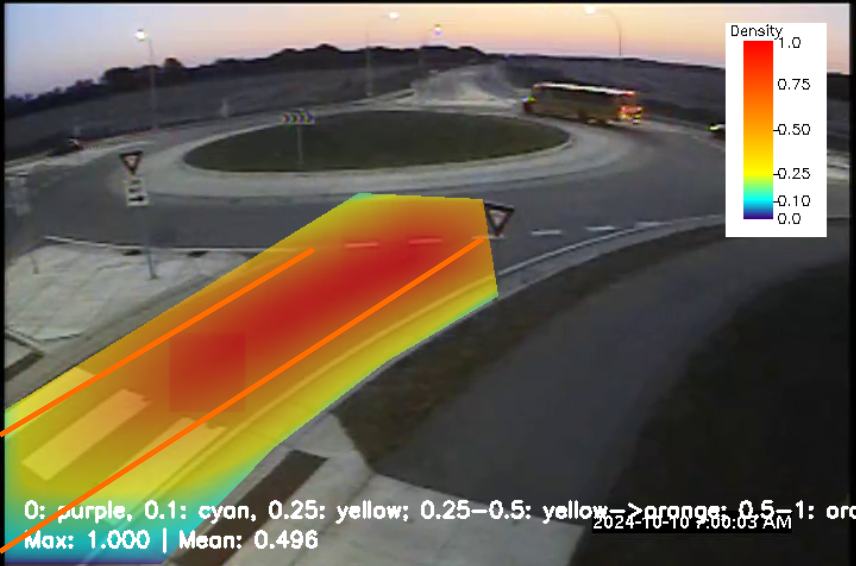
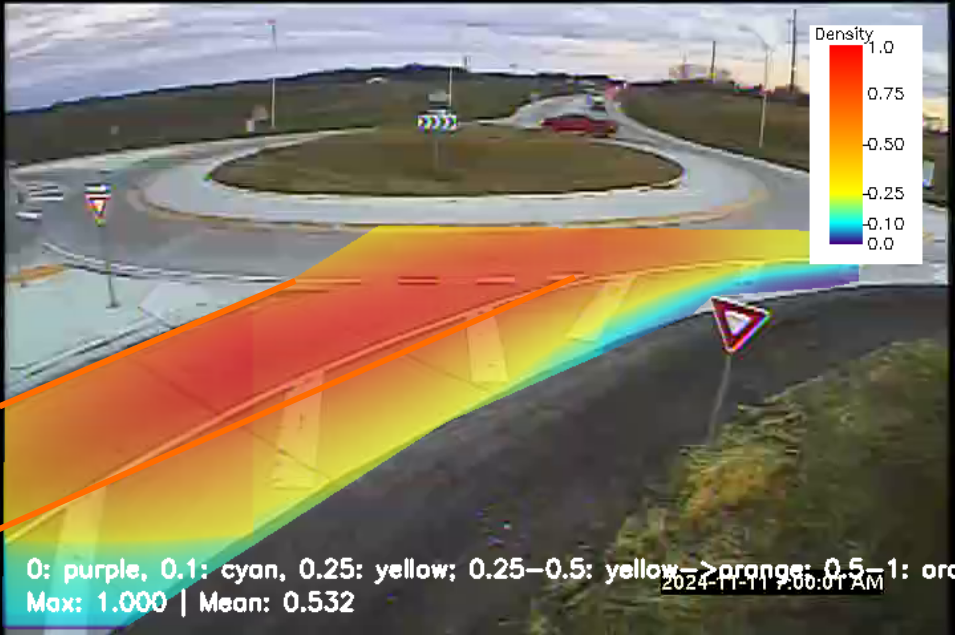
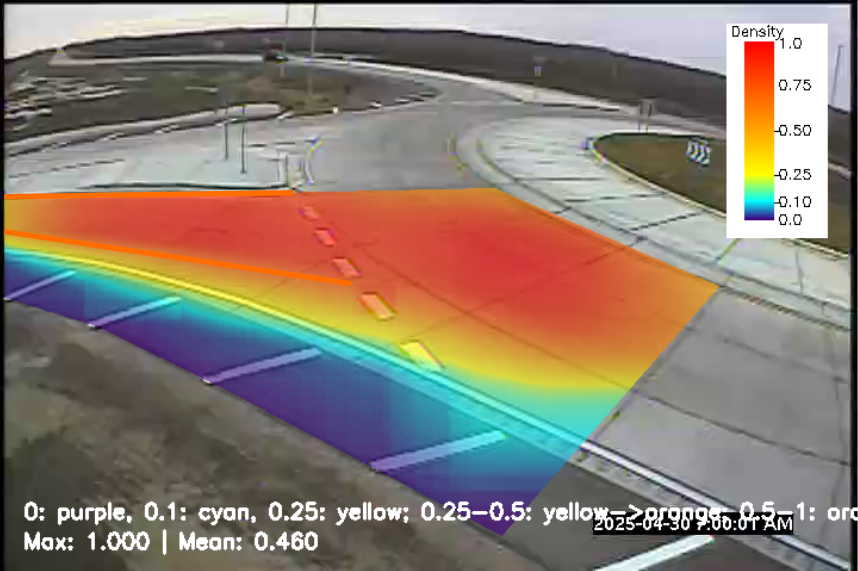
AI-powered video analysis data was collected at four separate roundabout locations and converted to color-coded heat maps to help visualize information gathered.
Conclusions
The Rural Roundabout Study project conducted by MnDOT’s GDSU will help shape the future of roundabout design in Minnesota. As part of the project, the project team heard from MnDOT districts in greater Minnesota that an urban design roundabout does not always fit the context of the area where most of the roundabouts are recommended. They are in rural areas with no pedestrian facilities, and it can violate driver expectations, as well as potentially serve as a liability risk should pedestrian facilities not get plowed right away during snow events.
This study confirmed that drivers drive rural designed roundabouts differently than urban designed. However, with a few countermeasures, a rural designed roundabout can function similar to an urban designed roundabout without violating driver expectations. By using vehicle trajectory lines and vehicle entry speeds, the team was able to prove that these countermeasures can significantly improve the performance of rural roundabouts and are useful tool in our toolbox. This work will help shape rural roundabout design in the future across Minnesota and can hopefully provide a starting point for additional research both in Minnesota and other locations across the Midwest.

jsebens@srfconsulting.com
763.249.6743
Justin Sebens, PE, is a Senior Project Manager specializing in Transportation Mobility. With over 12 years of experience in the private sector, Justin has worked on a variety of projects, including corridor studies, safety analyses, and video-based data collection for federal, state, and local clients. His expertise in video-based data collection has been instrumental in enhancing the accuracy and efficiency of transportation studies. By utilizing video technology, Justin can gathers detailed traffic data, monitors traffic patterns, and identifies safety issues more effectively. This approach allows for a comprehensive analysis of existing conditions, with a particular focus on corridor safety.
Justin’s work primarily involves preliminary engineering and alternative analysis projects. He excels in translating complex analysis into understandable information for the public through open houses, city council meetings, and policy advisory committee meetings. Justin’s experience with the University of Wisconsin Traffic Operations and Safety (TOPS) laboratory has provided him with a strong foundation in research-based projects and teaching transportation-focused courses. He leverages these skills, along with his public speaking abilities, to foster an educational environment that advances transportation safety.