

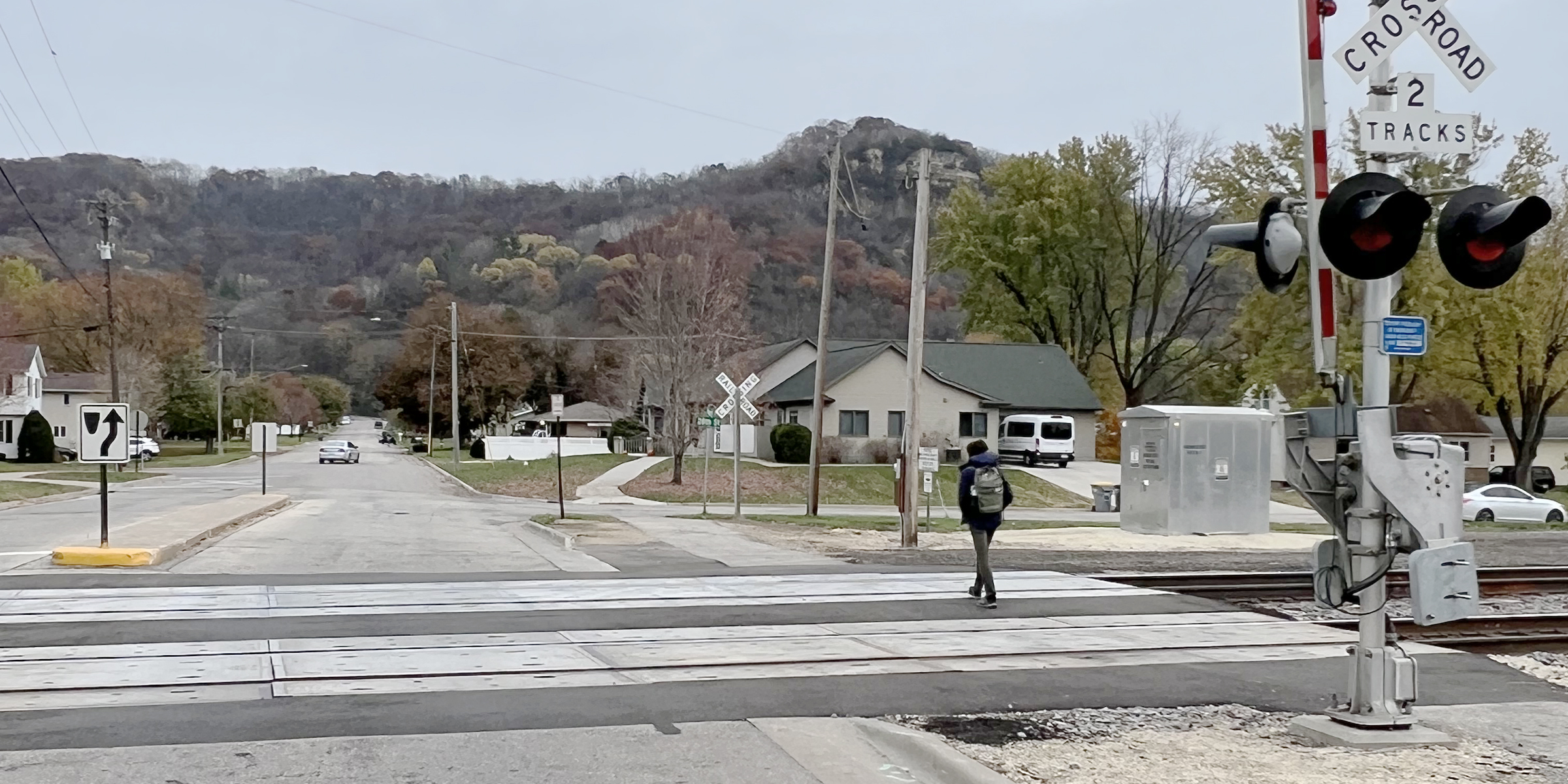
Every day, millions of Americans cross railroad tracks on their way to and from work, school, shopping or recreational activities. At-grade crossings of roads and train tracks are essential intersecting nodes of our multimodal transportation networks, but these intersections also represent points of potential conflict. The national “See Tracks? Think Train” campaign, held this week, is a critical reminder of the need for constant awareness around trains and tracks. For us at SRF, it’s also a time to reflect on our role as planners and engineers to proactively design safer communities.
Safety is more than a slogan; it’s the fundamental principle behind our comprehensive approach to rail planning. We partner with communities across the country to diagnose hazards, design tailored safety solutions and build a future where roadways and railways coexist safely and efficiently. Here’s a look at how we’re turning that principle into practice.
Improving Daily Life with Quiet Zones in Ann Arbor, Michigan
For a historic college town like Ann Arbor, safety is paramount. College campuses are bustling with students, residents, and visitors using active modes of transportation, transit and cars, especially when the Wolverines are at home. The need for enhanced crossing safety is clear. We are proud to be partnering with the City of Ann Arbor and the University of Michigan to implement a quiet zone, a solution that enhances safety while significantly reducing train horn noise.
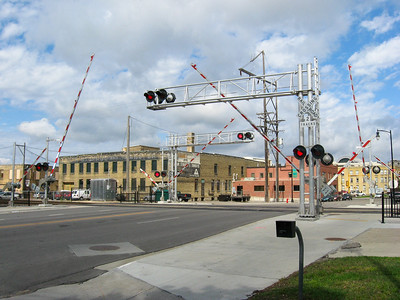
This project involves upgrading crossing infrastructure to meet stringent federal safety standards, allowing locomotives to pass through without sounding their horns. The result is a win-win: updated, safer crossings for pedestrians and vehicles, and a greatly improved quality of life for residents, who will no longer be disrupted by routine horn blasts. It’s a practical solution that makes the community both safer and more pleasant.
Building the Blueprint for a Safer Danville, Illinois
Danville has a rich rail history, but with it comes a complex challenge: over 30 at-grade crossings that create daily delays and safety concerns for residents and emergency responders. To address this long-standing issue, SRF is partnering with the City of Danville on a comprehensive Grade Crossing and Rail Consolidation Study.
Our approach combines comprehensive stakeholder engagement with advanced data analysis to create a clear path forward. Using innovative tools like SRF’s Rail Crossing Assessment Tool (SRF-RCAT) and partnering with TRAINFO, a data technology firm, allows us to evaluate and rank potential improvements across dozens of crossings in a rail corridor. The ultimate goal is to deliver a data-driven blueprint that prioritizes solutions, such as grade separations or crossing consolidations, and position the City to successfully compete for state and federal funding to turn these plans into reality.
Envisioning a Transformative Future in Rapid City, South Dakota
Sometimes, the most effective solutions requires thinking beyond just a grade crossing. In Rapid City, the SRF team is leading a groundbreaking study to evaluate the potential relocation of a major railyard. This ambitious and visionary project seeks to do more than just move a railyard; it aims to reimagine the city’s landscape.
By exploring the relocation of the railyard, the study is identifying opportunities to eliminate numerous at-grade crossings, untangle traffic congestion, enhance community safety, and unlock valuable land for economic development and public use. This is a prime example of how strategic transportation planning can be a catalyst for transformative community change. To learn more about this exciting effort, visit the Railyard Relocation & Railroad Configuration Study project website (rcrailyardstudy.com).
Providing Tailored Guidance for Municipalities Nationwide
No two communities have the same rail challenges. That’s why a significant portion of our work involves providing expert, customized support to local and regional governments. We help our partners analyze their specific needs and develop strategic, data-driven action and implementation plans.
Recently, our work has included:
- Partnering with the Western Connecticut Council of Governments to develop a comprehensive regional action plan for improving crossing safety across multiple communities.
- Assisting the City of Sioux City, Iowa, with a detailed diagnostic review of key crossings to identify targeted safety improvements.
- Supporting the City of Columbus, Nebraska, in its efforts to create a safer and more efficient rail corridor through the heart of their community.
By acting as a trusted advisor, we empower communities to make informed decisions that have a lasting, positive impact on public safety.
Looking Ahead: The Future of Rail Safety
These projects represent just a fraction of the ongoing effort to improve rail safety. With new opportunities on the horizon, like the federal Railroad Crossing Elimination (RCE) grant program, the national commitment to creating safer rail corridors is stronger than ever.
At SRF, we are excited to be at the forefront of this work. We are continuously developing innovative solutions and stand ready to help our partners navigate the future of rail funding and design. Because when we see tracks, we don’t just think “train,” we think of safer, stronger, and more connected communities.
Did you know?
The SRF Funding and Grants team secured a $4.9 million FY 22 RCE Grant in Kandiyohi County for an overpass of CSAH 55. Further, in FY 24, the team assisted South Dakota Department of Transportation in securing $1 million in funding for the Sioux Falls Railroad Corridor Analysis and Crossing Safety Study. The team also prepares federal grant applications for rail related projects through CRISI and INFRA programs that are set to open with Notice of Funding Opportunities (NOFO) in fall 2025.